The artist
Alain Mathiot
A painter of primal figures and signs, Alain Mathiot lives and works in Hugier, Haute-Saône. His work, begun more than sixty years ago, has been shown from Paris to New York.
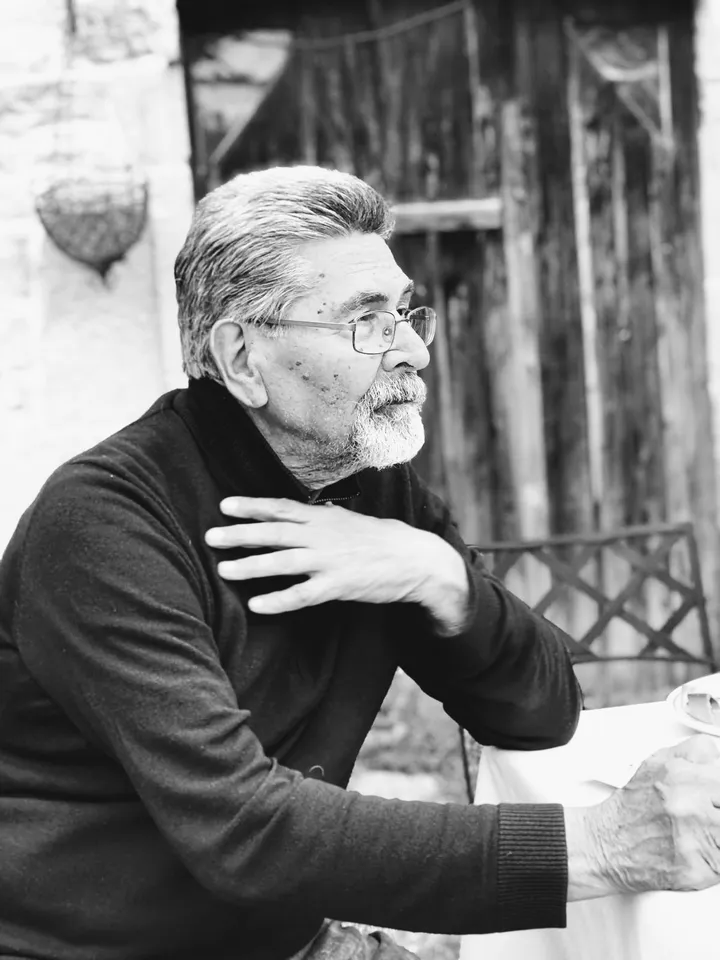
The career
Born in 1938, Alain Mathiot was noticed early: in 1961 the first Fénéon Prize — a distinction awarded by the University of Paris to young artists — honoured his work. From 1963, the Kriegel gallery in Paris devoted an exhibition to him, the first of a long series.
Four decades of regular exhibitions followed: the Parisian galleries Kriegel, Mouton, Lucien Durand and later Krief; Lyon with the galleries l’Ollave and Vannoni; Switzerland in Nyon; the museums of Vesoul and Héricourt; and finally New York, where RVS Fine Art in Southampton presented his work in 1990. In 1992 the Krief gallery showed him at the FIAC in Paris.
Far from fashions, Mathiot pursues a stubborn search: bringing forth figures — humans, animals, objects — reduced to their essential masses, accompanied by signs, between childhood memory and collective memory.
Today, from his studio in Hugier, he works in series — the walls, the white grounds, the donkeys — where oil, felt pen and pastel converse on paper as on canvas. Painting remains what it has always been for him: a writing from before alphabets.
Critical views
Alain Mathiot is not innocent of primitivisms of every kind; he is curious about them, he even cultivates his knowledge of them, the better to spur it on when the moment of creation comes. But where others would strive not to lose any of their symbolic value in order to play on the effects of an archaic memory, Mathiot seems to adopt an attitude against the current. He seeks to detach his subject from the place of its source, to offer it to our gaze on the threshold of a greater history. His figures themselves are quite astounded by it; surprised by this digression, they stare at us through their masks as one discovers something unheard of — and the viewer finds himself in the position of the viewed. If by chance we pierce their secret, Mathiot then has an unstoppable recourse — that of blurring. He drowns our gaze in the inextricability of an image where everything tips over; we no longer know where to turn and, as in those unforgettable sequences of Hellzapoppin, we remain stunned. What is this bovine head doing here? What is that canine silhouette? Who is this strange character signalling to? The confusion of values here returns the viewer to such a state of innocence that one cannot emerge unscathed from the company of this painting. It forces us to disarm, because it operates out of reach of the harmful — let us repeat, this painting is in/nocent, in the first sense of the word — and its only intention is to invite the mind to wander off the beaten furrows.
Philippe Piguet, Hors des sillons, 1989
Amid the images, among the images, within the images, the landscapes of painting appear with their processions of dark, warm colours, heightening and magnifying the subjects, as if the themes made the painting surge forth more strongly, and as if the painting took on a vaster power thanks to the interlacing of figures peopling the whole canvas. The characters, human or animal, that invade the paintings — from rituals, celebrations, Indians and movie cowboys to today’s emblematic figures — become schematic and simplified into almost symbolic forms, accompanied by signs. Mathiot moves away from anecdotal figuration as from illustration, in search of the territory of vision. He brings back a buried world of childhood and folk tales, a world where images are vivid and speaking, as if the painter became the medium of collective memory, the diviner of fundamental images and their keeper, speaking with painting the language of symbols, opening doors and sending out calls, signs, gestures, cries. The great Indians in particular, in their tragic splendour, with their horses and their dogs, transmit a word of solitary resistance and of liberation of the soul. These figures now attain a singular mythical power, far from any reference, as if they surged from an elsewhere, hieratic, dignified and serene. Painting regains its rights: it magnifies and exalts the symbolic figure, which becomes a wild icon, a totemic emblem. Primitive paintings, first paintings, archetypal paintings. Mathiot’s canvases are imbued with a kind of dark grandeur — a kind of visible poem, a pictorial word in which a painter, a human being, tries to say, simply: “become the king of your kingdom and meet your brother kings, far from the vain noise of false glory”.
Michel Giroud, Les Figures de la Peinture, 1989
Milestones
- 1938
Alain Mathiot is born.
- 1961
First Fénéon Prize, awarded by the University of Paris.
- 1963
First exhibition at the Kriegel gallery, Paris.
- 1990
Exhibition at RVS Fine Art, Southampton, New York.
- 1992
FIAC Paris, with the Krief gallery.
- 2025
Exhibition rue du Capitaine Faure, Besançon.
- 2026
He continues to paint in his studio in Hugier, Haute-Saône.
Discover the work
Paintings on canvas and works on paper, from 1978 to today: the gallery brings together a representative selection of his work. Several pieces are available to collect, and the artist answers every request personally.